PCKR Self-Evaluation

Note: This tool is still in development and may change without notice. 

Pedagogical Content Knowledge about Religion – Self-Evaluation

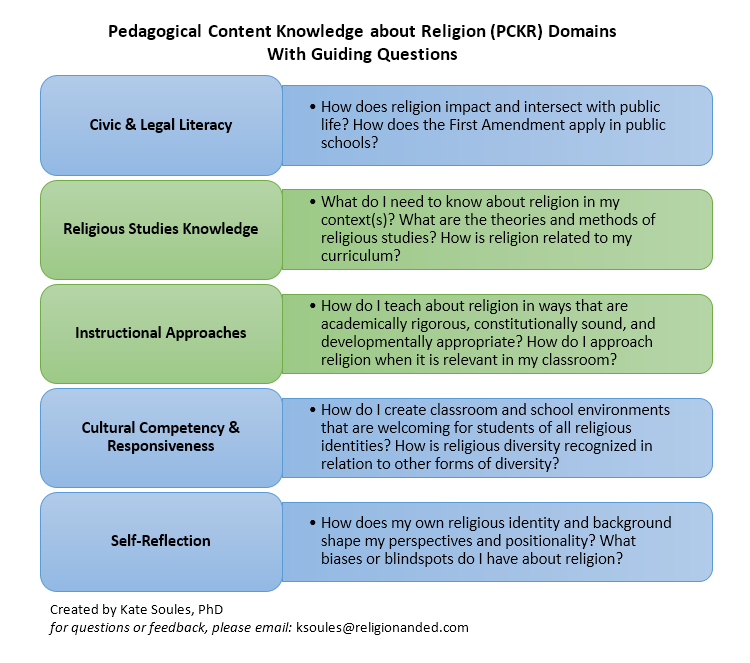
The Pedagogical Content Knowledge about Religion framework breaks down the broad concept of “religious literacy” into five domains. The framework is designed specifically for educators in elementary and secondary schools and is applicable for teachers in all content areas. The domains each describe one element of religious literacy in the school context, helping educators identify areas of strengths and specific and actionable areas for growth.

Instructions:

This is a draft version of a self-assessment tool based on the Pedagogical Content Knowledge about Religion theoretical framework (Soules, 2019). It is intended to provide you with a set of reflection questions within each of the domains to identify areas for further growth and learning. The PCKR framework has been designed to be applicable for teachers across grade levels and content areas. While some questions may not be relevant for educators working outside of the classroom (e.g. counselors, administrators, etc.), the tool can still offer valuable questions for discussion.

Note: Not all questions are weighted equally within a domain, and the weight of each question within a domain may vary depending on your context. Your score should only be used as a starting point for further discussion and reflection.

For additional information on the PCKR framework and the evaluation tool, please contact Kate Soules (ksoules@religionanded.com)

1 / 40

Category: Civic & Legal Literacy

Are there any religion-related current events (local, national, or global) impacting your school community? Are you comfortable discussing these with students?

2 / 40

Category: Civic & Legal Literacy

Have there been any significant changes in this composition over time?

3 / 40

Category: Civic & Legal Literacy

What is the general religious composition of the community in which your school is located?

4 / 40

Category: Civic & Legal Literacy

What is the general religious composition of your school?

5 / 40

Category: Civic & Legal Literacy

Who should you go to if you are uncertain about a First Amendment issue or how to address a religion-related issue?

6 / 40

Category: Civic & Legal Literacy

What are your school and/or districts policies regarding teaching about religion, religious holiday, religious garb, and other related topics?

7 / 40

Category: Civic & Legal Literacy

Do you know the differences between how students can express their religious identities and how teachers may express religious identities?

8 / 40

Category: Civic & Legal Literacy

Are you confident in your understanding of the application of the religion clauses of the First Amendment in your school context?

9 / 40

Category: Religious Studies Knowledge

What are the components of religious identity? How do you talk about religious identity?

10 / 40

Category: Religious Studies Knowledge

How do you define religion in relation to your curriculum?

11 / 40

Category: Religious Studies Knowledge

What are the basic premises of religious studies?

12 / 40

Category: Religious Studies Knowledge

What are your sources for your content knowledge? What sources do you go to when you don’t know something?

13 / 40

Category: Religious Studies Knowledge

In what areas would you like to increase your content knowledge?

14 / 40

Category: Religious Studies Knowledge

How confident are you with your knowledge and understanding of that content?

15 / 40

Category: Religious Studies Knowledge

How does religion content connect to your curriculum in explicit or implicit ways?

16 / 40

Category: Religious Studies Knowledge

What religion content do you need to know related to your context(s) (e.g. about religions represented in the school community, in the books you teach, etc.)?

17 / 40

Category: Instructional Approaches

Can you explain your curricular and pedagogical approaches to teaching about religion to administrators and/or parents who express concerns?

18 / 40

Category: Instructional Approaches

How do you prepare for fieldtrips or guest speakers to ensure they are constitutionally appropriate and academically rigorous?

19 / 40

Category: Instructional Approaches

How do you prepare students to have difficult conversations about controversial topics? What are your classroom expectations about civil dialogue?

20 / 40

Category: Instructional Approaches

Do classroom activities require students to do anything that might be perceived as practicing religion (e.g. role play or simulations)?

21 / 40

Category: Instructional Approaches

Are your curriculum materials constitutionally appropriate in regards to religion?

22 / 40

Category: Instructional Approaches

Do the materials present multiple perspectives and diversity within religious tradition?

23 / 40

Category: Instructional Approaches

What curricular materials do you use when teaching about religion?

24 / 40

Category: Instructional Approaches

How do you respond when a student brings up religion in a classroom discussion?

25 / 40

Category: Cultural Responsiveness

Are you attentive to religiously diverse practices, perspectives, and experiences of all members of the school community, including parents, teachers, and other staff?

26 / 40

Category: Cultural Responsiveness

Does your school and/or classroom library include books with religiously diverse characters?

27 / 40

Category: Cultural Responsiveness

Is religiously-based bullying included in any anti-bullying curriculum?

28 / 40

Category: Cultural Responsiveness

Does your school implicitly or explicitly privilege any particular religious group (e.g. celebration of holidays, decorations, etc.)? Does your school implicitly or explicitly discriminate towards any religious group (e.g. scheduling of events, not providing kosher/halal food options, etc.)?

29 / 40

Category: Cultural Responsiveness

Are students aware of their rights regarding their religious expression and practice?

30 / 40

Category: Cultural Responsiveness

Do you take students’ (and families’) religious practices into account when scheduling exams, field trips, parent meetings, etc.?

31 / 40

Category: Cultural Responsiveness

How is religious diversity recognized in relation to other forms of diversity?

32 / 40

Category: Cultural Responsiveness

Do you include religion when you talk about diversity or multicultural education?

33 / 40

Category: Self-Reflection

How does your religious or spiritual identity, if any, intersect with other aspects of your identity (race, gender, etc.)?

34 / 40

Category: Self-Reflection

Are there practices from your religious or spiritual tradition that you can draw on when teaching is challenging or for self-care? When you draw on those practices?

35 / 40

Category: Self-Reflection

Does your religion play a role in motivating you as an educator? If so, in what ways?

36 / 40

Category: Self-Reflection

What does your religious tradition, if any, say about teaching and education?

37 / 40

Category: Self-Reflection

Do your biases or assumptions about religion impact how you approach certain curricular content?

38 / 40

Category: Self-Reflection

Do your biases or assumptions about religion impact your relationships with students?

39 / 40

Category: Self-Reflection

What assumptions do you make about people based on their religious or non-religious identities?

40 / 40

Category: Self-Reflection

Have you reflected on your own biases towards religion in general, non-religion, or specific religions?

Optional Information

The following section is completely optional. If you would like your name to appear on your certificate of your results, please provide a name.

This tool is still being developed and any feedback you have will help to improve it. You can write comments here or provide your email address to be contacted later for a short conversation to improve the tool.  

I am interested in being contact to provide additional feedback to help improve this tool.

The average score is 72%

0%